
Pulling Back the Curtain on FedRAMP 20x
AWS recently published a blog post on preparing for FedRAMP 20x and it’s worth reading. Not because the technology is surprising, but because of what it reveals when you look at what’s actually being described underneath.
Spoiler: it’s GRC engineering.
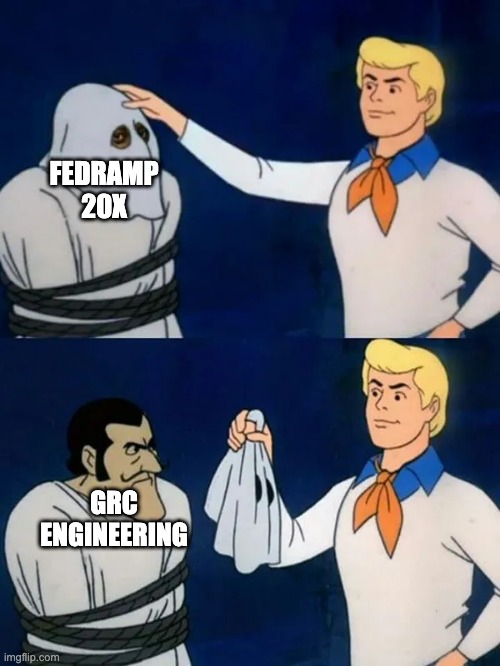
What FedRAMP 20x Is Actually Saying
The “20x” goal: making authorization 20 times faster is more than a catchy name. It’s the FedRAMP Board’s response to the FedRAMP Authorization Act, aiming to double the number of authorized services while reducing the time and cost.
The pitch of FedRAMP 20x is that it transforms compliance from a documentation exercise into a continuous, automated, engineering-driven discipline. Instead of 12-to-18-month authorization cycles built on static PDFs and point-in-time assessments, 20x demands machine-readable Key Security Indicators (KSIs), automated Vulnerability Detection and Response (VDR) pipelines, continuous configuration validation, and real-time Significant Change Notifications (SCNs).
The AWS blog translates this into a concrete architecture: Security Hub aggregating findings, Config tracking configuration state, Audit Manager collecting evidence, Inspector scanning workloads, CodePipeline running compliance gates in CI/CD, and EventBridge routing change events into automated SCN workflows. Crucially, it highlights AWS Glue and Athena transforming raw telemetry into OSCAL (Open Security Controls Assessment Language).
Read that list again slowly. Because here’s what you’re actually looking at:
- Config rules = policy-as-code enforcement with a continuous compliance state record
- Audit Manager = automated evidence collection mapped to a control framework
- Inspector + ECR scanning = continuous VDR baked into your workload lifecycle
- EventBridge + Lambda = an event-driven compliance notification engine
- CodePipeline gates = compliance as a CI/CD quality gate
- Glue + Athena = The ETL (Extract, Transform, Load) pipeline that turns security data into compliance artifacts.

None of this is new. None of this is FedRAMP-specific. What FedRAMP 20x has done is take the principles that good security engineers have been applying for years and formalize them as authorization requirements.
Two Disciplines, One Architecture
Before going further, it’s worth calling something out, because the distinction is the heart of the argument.
Security Engineering produces the signals. A well-architected AWS environment running Inspector and CloudTrail is continuously generating everything you would ever need to prove your control posture.
GRC Engineering produces the evidence. Raw signals are not compliance evidence. A Config finding in an S3 bucket is just data. GRC Engineering is the translation layer: defining control mapping schemas, writing OSCAL transformation pipelines, and tagging evidence to specific control families.
The accurate flow is: quality security engineering -> raw telemetry -> GRC engineering -> compliance evidence.
That Glue and Athena pipeline mentioned in the AWS blog—the one transforming raw telemetry into machine-readable authorization package outputs—that pipeline is GRC engineering in action.
The Curtain Pull: Compliance Evidence Is an Engineering Byproduct
Here’s the reframe: if you are doing cloud engineering well, compliance artifacts become a byproduct. Quality engineering and rigorous security implementation generate them for you—the only work left is collecting and putting them to use. This is where GRC engineering enters the game.
The ‘20x’ goal—making authorization 20 times faster—is achievable precisely because the evidence already exists in a well-engineered environment. By eliminating the manual assembly work, you’re not just saving time—you’re finally letting the compliance process move at the speed it was always capable of.
The AWS blog puts it plainly: “FedRAMP 20x treats security as an engineering discipline with measurable, verifiable outputs.” That sentence is the entire basis of GRC Engineering.
Decoding the 20x Deliverables
Let’s decode the three core 20x deliverables and what they really represent as engineering constructs.
- Key Security Indicators (KSIs): These are just structured query outputs against existing telemetry (IAM, KMS, VPC Flow Logs). A KSI pipeline is an analytics engineering project applied to your security posture.
- Vulnerability Detection and Response (VDR): This is a formalization of DevSecOps: continuous scanning and automated remediation with a documented trail.
- Significant Change Notifications (SCNs): This is an event-driven architecture with a compliance reporting endpoint.
Underpinning all of this is the Minimum Assessment Scope (MAS). MAS is the scoping mechanism that defines exactly where security rigor is required. If your GRC Engineering is on point, the MAS becomes your data-gathering boundary, ensuring you aren’t over-collecting or missing critical signals.
The Framework Portability Problem
If FedRAMP 20x is just GRC engineering applied to a federal framework, then the same architecture with adjusted mappings serves every other regime.
The Config rules you write for FedRAMP? Re-map them to NIST 800-171 for CMMC. The Security Hub findings? Tag them against SOC 2 Trust Services Criteria.
This is the real value: The infrastructure compounds. The marginal cost of satisfying an additional framework drops because you aren’t rebuilding the collection layer—you’re just extending the mapping schema.
Organizations still running compliance as a periodic manual process—the “annual audit scramble” model—pay this cost repeatedly, in full, for every framework. Organizations that have internalized GRC engineering pay it once and amortize it across everything.
What This Means If You’re Building Now
The AWS blog frames 20x readiness as a phased effort: baseline your environment, automate evidence collection, then operationalize continuous validation. That’s a reasonable implementation roadmap. But the architectural intention needs to precede all of it.
The right question to ask at design time isn’t “how do we meet FedRAMP requirements?” It’s: what evidence will this component need to produce, and how does our GRC engineering layer collect, map, and surface that evidence against the controls we’re accountable for?
That is the heart of FedRAMP 20x. It is the formalization of what should have been standard practice: building systems where compliance isn’t an ‘audit scramble,’ but a continuous, automated byproduct of engineering excellence.